Text-to-Image Workflow
DTLA 2076: CO₂ Reappraised — Westin Bonaventure Hotel adaptive reuse
- Format
- Workflow Board
- Tools
- Midjourney v6.1 · Claude · DALL·E 3
- Course
- AI for Architects — ELVTR
Research Material & References
Research boards, reference images, and AI conversation screenshots document the prompt development process that guided all generated visualizations. These are source references and process documentation — not AI outputs.
Prompt → Model → Iteration → Curation
Research materials were analyzed and formulated into structured text prompts; a platform was chosen per output type; each prompt ran a minimum of three times; the best iterations were selected per visualization category.
Prompt Engineering
Environmental concepts, material palettes, and atmospheric qualities formulated into structured text prompts for each visualization type.
AI Model Selection
Midjourney for photorealistic renders, Claude for prompt engineering and guidance, DALL·E 3 for sketch and concept outputs.
Iteration + Refinement
Each prompt run at least three times, adjusting composition, lighting, style keywords, aspect ratio, camera angle, and environmental detail.
Output Curation
Best iterations selected per category, evaluated for architectural accuracy, environmental narrative clarity, and representation quality.
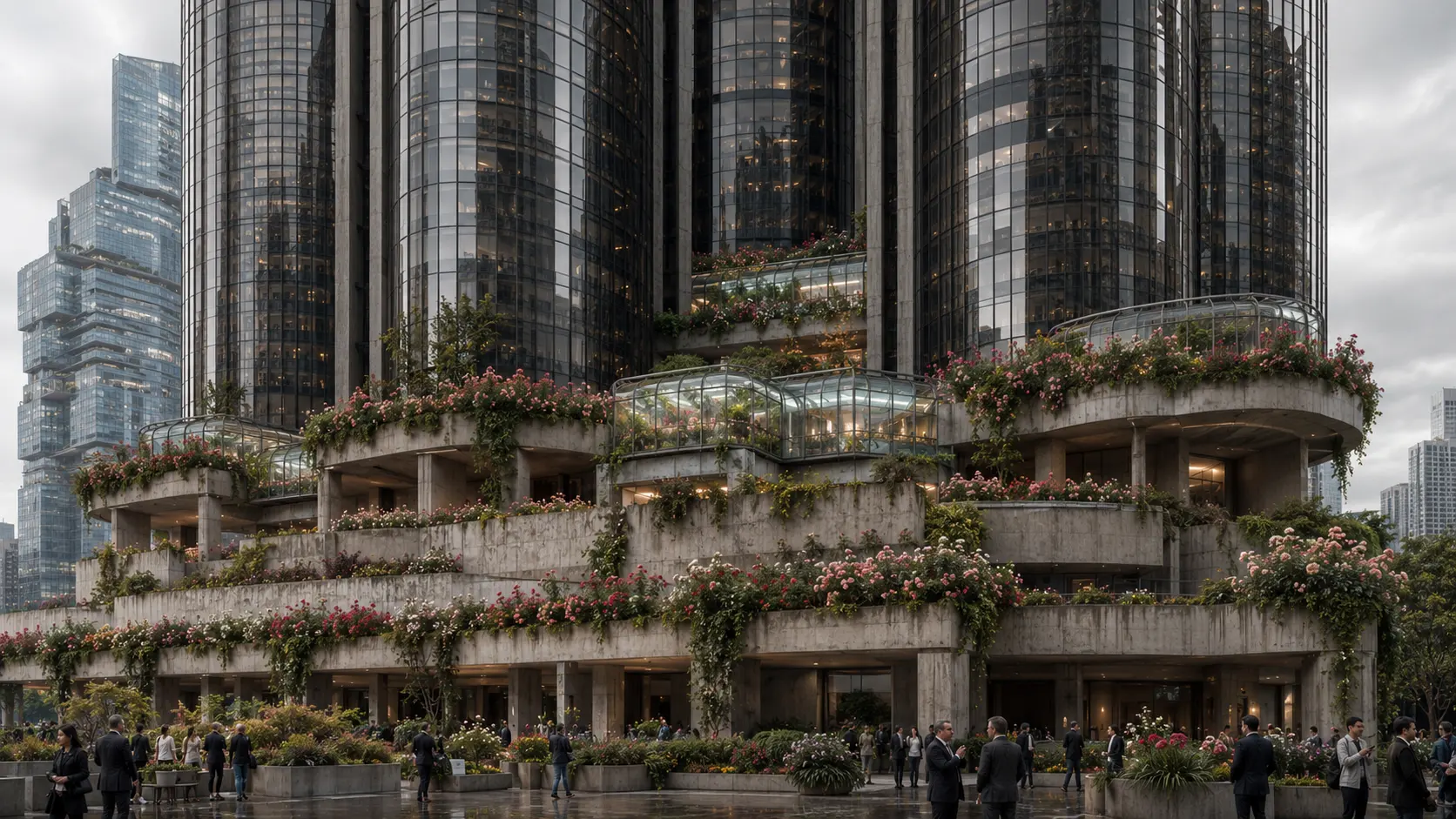
/imagine prompt:
photorealistic architectural visualization, close-up elevation of the Westin Bonaventure Hotel DTLA 2076, adaptive reuse with lush rose gardens integrated into podium terraces, cascading rose planters wrapping around the concrete base, elevated greenhouse walkways between cylindrical towers, soft brutalist edges with biophilic landscape retrofit, close street level view, atmospheric overcast Los Angeles light, people interacting within garden terraces, cinematic architecture photography --ar 16:9 --v 6.1 --style raw --q 2 --iw 1.5 --no text, labels, writing, annotations
Three Categories, Three Iterations Each
Diagrammatic, sketch/concept, and photorealistic visualizations — each category developed through three iterative outputs, from HVAC thermal axonometrics to greenhouse thermal-chimney sections and street-level cinematic renders.
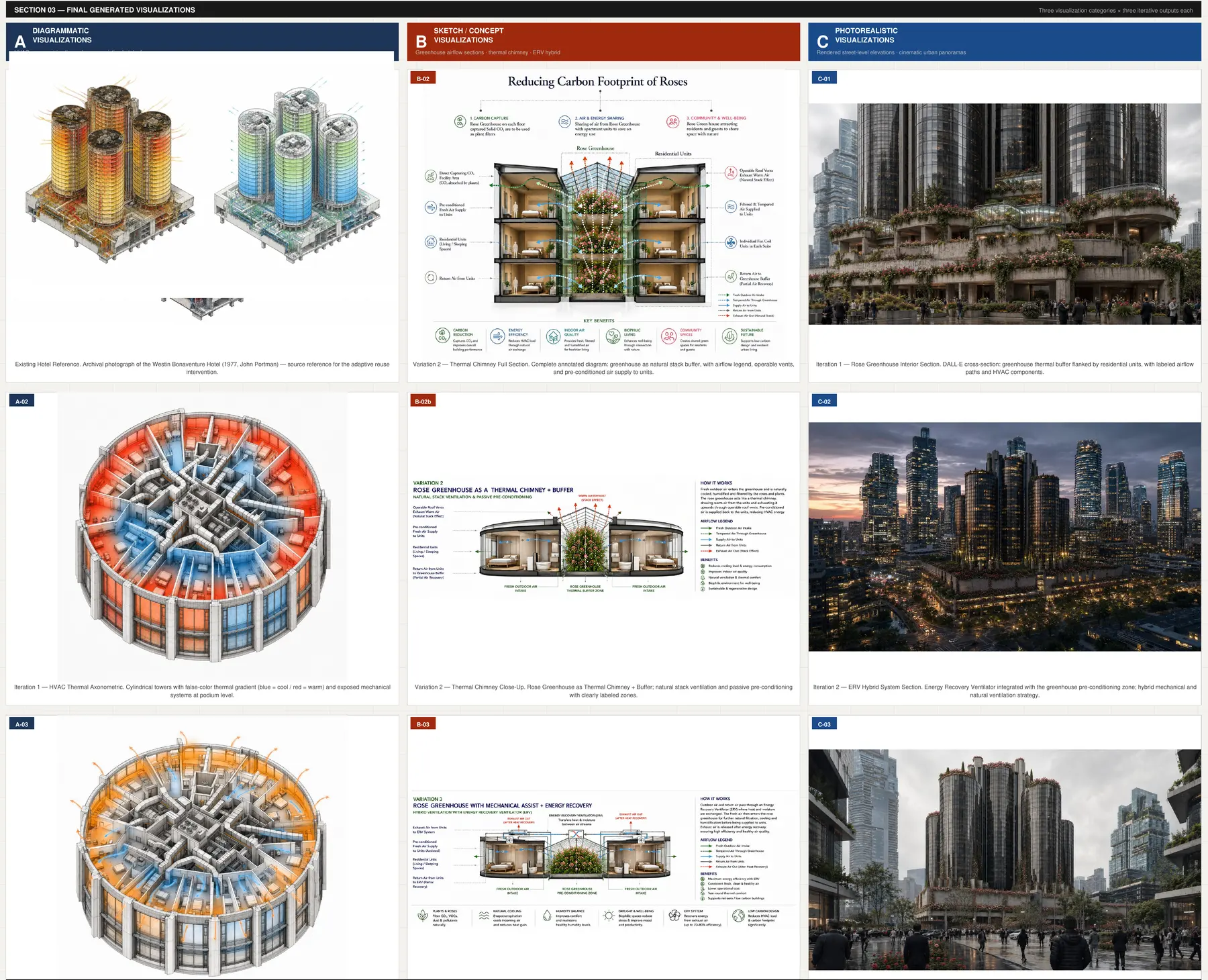
Three platforms in sequence
Midjourney v6.1 for photorealistic renders · Claude for prompt engineering and guidance · DALL·E 3 for sketch and concept outputs.
Minimum three per visualization
Refined through prompt changes, style, composition, and lighting; outcomes compared and the strongest selected for clarity and impact.
A sustainable urban landmark
Communicate the future adaptation of the Bonaventure through biophilic greenhouse integration, rose gardens, passive ventilation, and hybrid HVAC strategies — a low-carbon, people-centric landmark.
The most effective part of this workflow was using Claude, Midjourney, and ChatGPT together in sequence. Claude read the thesis research and translated complex architectural ideas into detailed, specific prompt language — this was the most critical step, since better prompts consistently produced better images. Midjourney then rendered the photorealistic outputs, performing strongest when lighting, materials, and atmosphere were clearly described. ChatGPT with DALL·E handled the technical diagrams, where plain explanatory language worked better than cinematic description.
The key lesson was specificity — prompts grounded in real research terms produced results that were both architecturally accurate and visually compelling. Running each prompt three times allowed the first iteration to establish composition, the second to refine atmosphere, and the third to lock in environmental detail.