Image-to-Image Visualization
Westin Bonaventure Hotel — architecture, urban design & net zero study
- Format
- Visualization Study
- Tools
- AI Image-to-Image · Hand Drafting · Net Zero Strategies
- Course
- AI for Architects — ELVTR
Site Context & Urban Presence
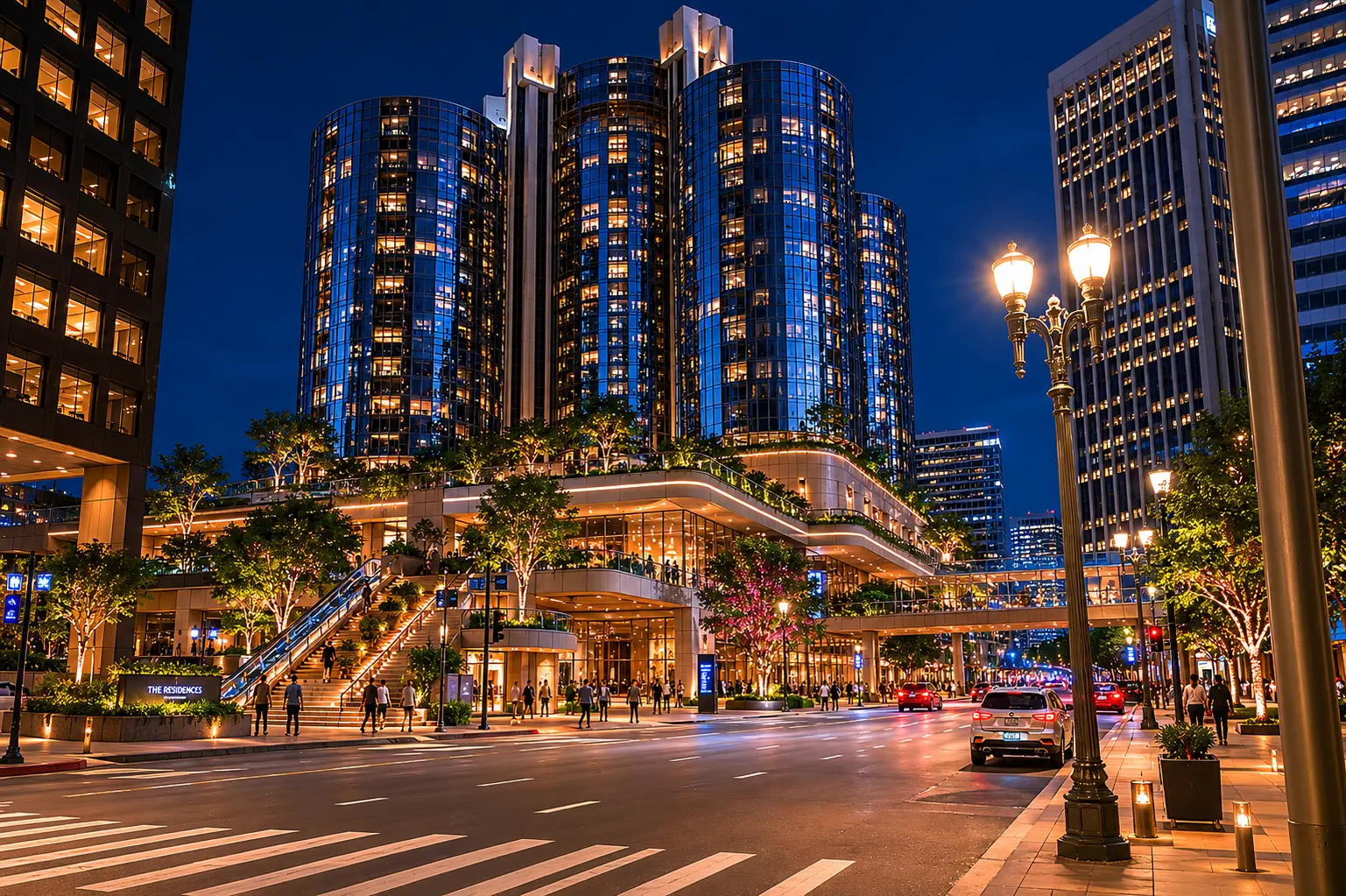
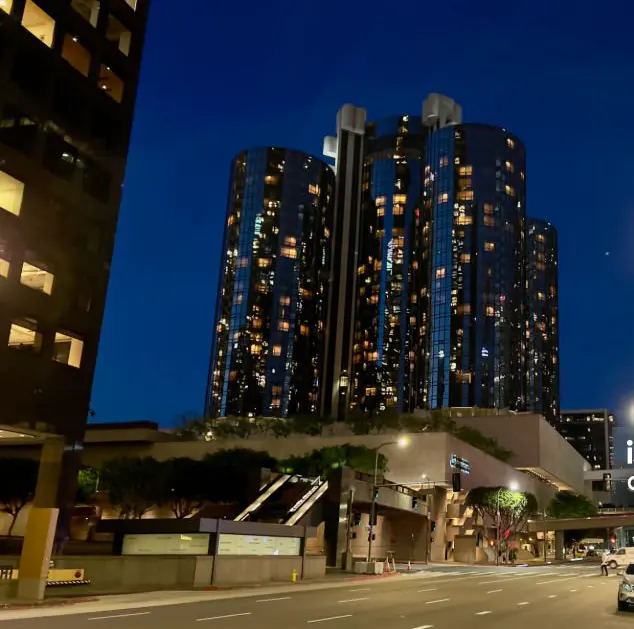
The Westin Bonaventure Hotel — a cluster of five cylindrical glass towers rising from a concrete podium in downtown Los Angeles — is one of the city’s most recognisable landmarks. Yet for decades its ground level has functioned as a wall rather than a welcome. This section documents both the problem and the proposed resolution.
Despite the hotel’s iconic silhouette, the podium turns its back on the street. At grade, pedestrians encounter exposed concrete walls with service access facing the boulevard; no active frontage, retail, or visual connection to the hotel interior; minimal planting — no shade trees, no seating, no reason to pause; a car-priority arrival loop that breaks the pedestrian path; and entries tucked away, with no clear signal of welcome from the street.
The AI visualisation proposes a fundamental reimagining of the base — one that turns the podium into a landscape destination rather than a circulation barrier: cascading terraced gardens along the full boulevard frontage, active retail and café spill-out at every terrace level, illuminated stairways that invite pedestrians up and through, dense tree canopy providing shade and softening the concrete edge, and a fully glazed lobby that opens the hotel visually to the city.
Architectural Section Iterations
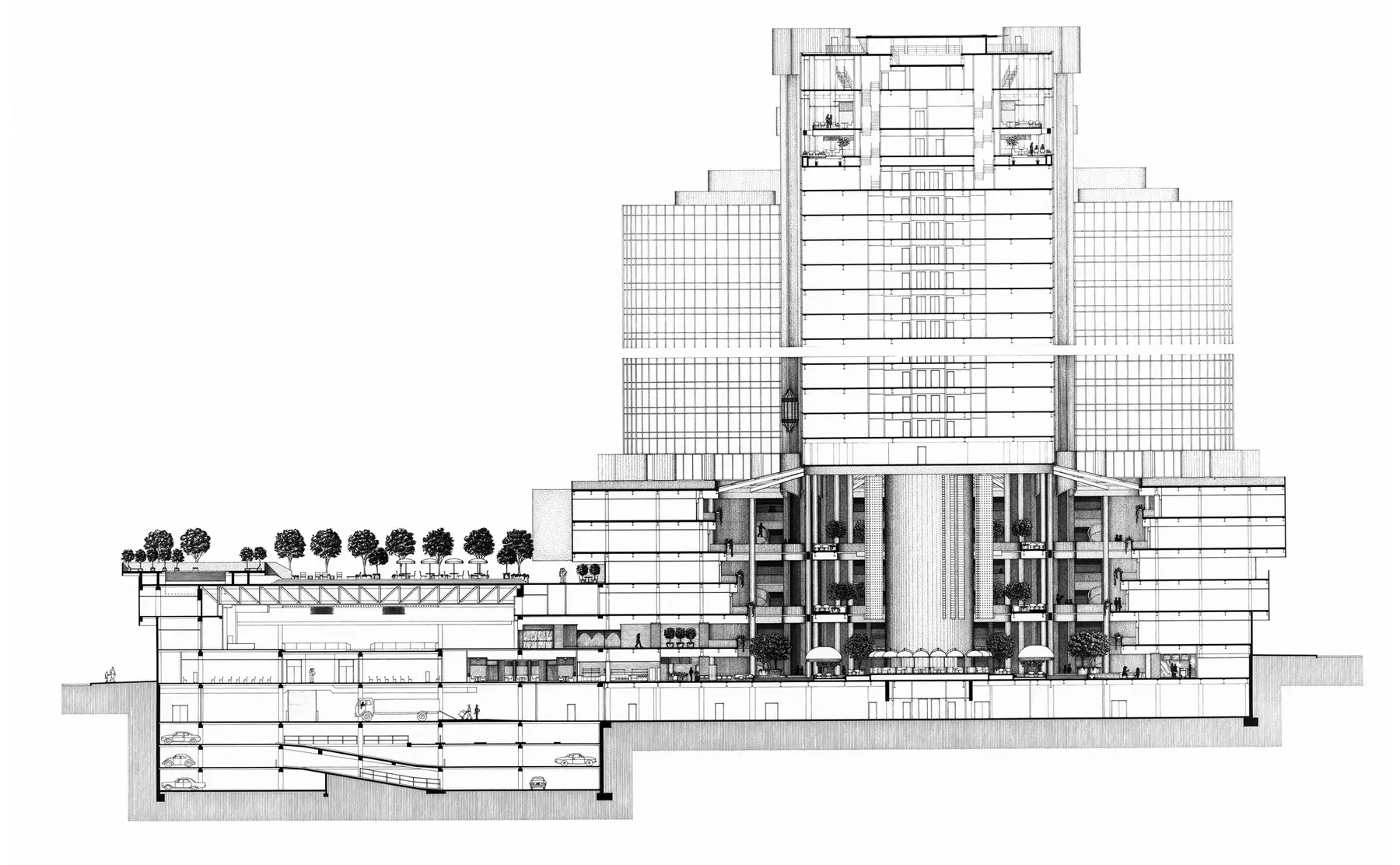
Starting from a hand-drafted pencil section of the Bonaventure’s existing massing, three progressive AI image-to-image iterations develop the design — introducing biophilic planting, landscape character, and finally a speculative future vision. Each iteration uses the previous image as its input, building complexity and atmosphere pass by pass.
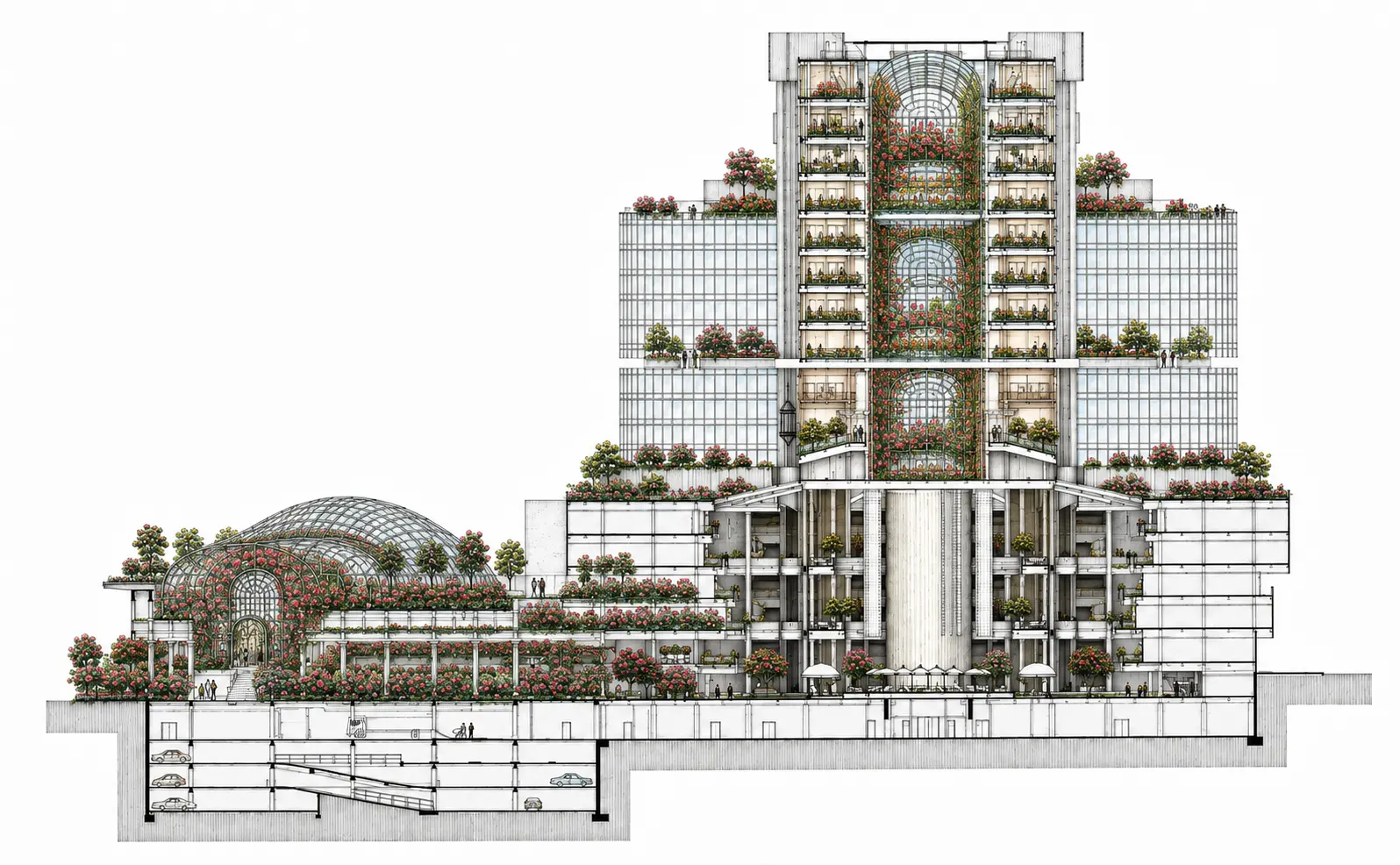
Coloured architectural section drawing of a stepped mixed-use tower with biophilic design, rose gardens cascading on every terrace level, a glass dome conservatory at base left, central tall cylindrical atrium with people inside, underground parking below grade. Hand-drawn linework with architectural colour rendering — soft pinks and corals for flowers, greens for trees and planters, warm beige section fills, white background.
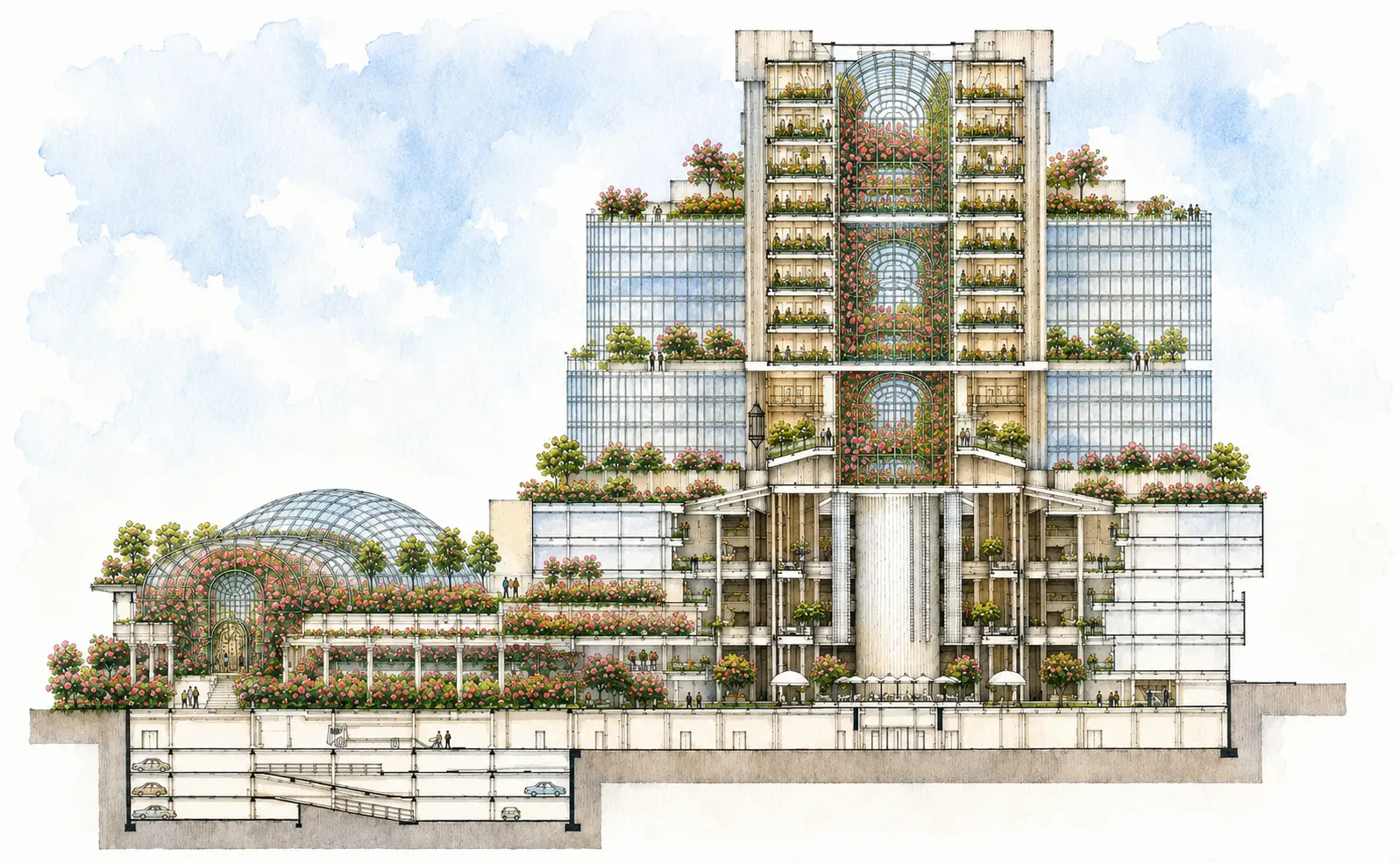
Watercolour architectural section rendering of a stepped mixed-use urban tower, rose garden terraces blooming on every level, glass arched conservatory at lower left, central atrium with cascading waterfall and tall white cylindrical column, stepped glass-and-concrete tower above. Soft blue watercolour sky wash background, pink and coral flower washes, loose painterly style, white paper ground, architectural scale figures on terraces.
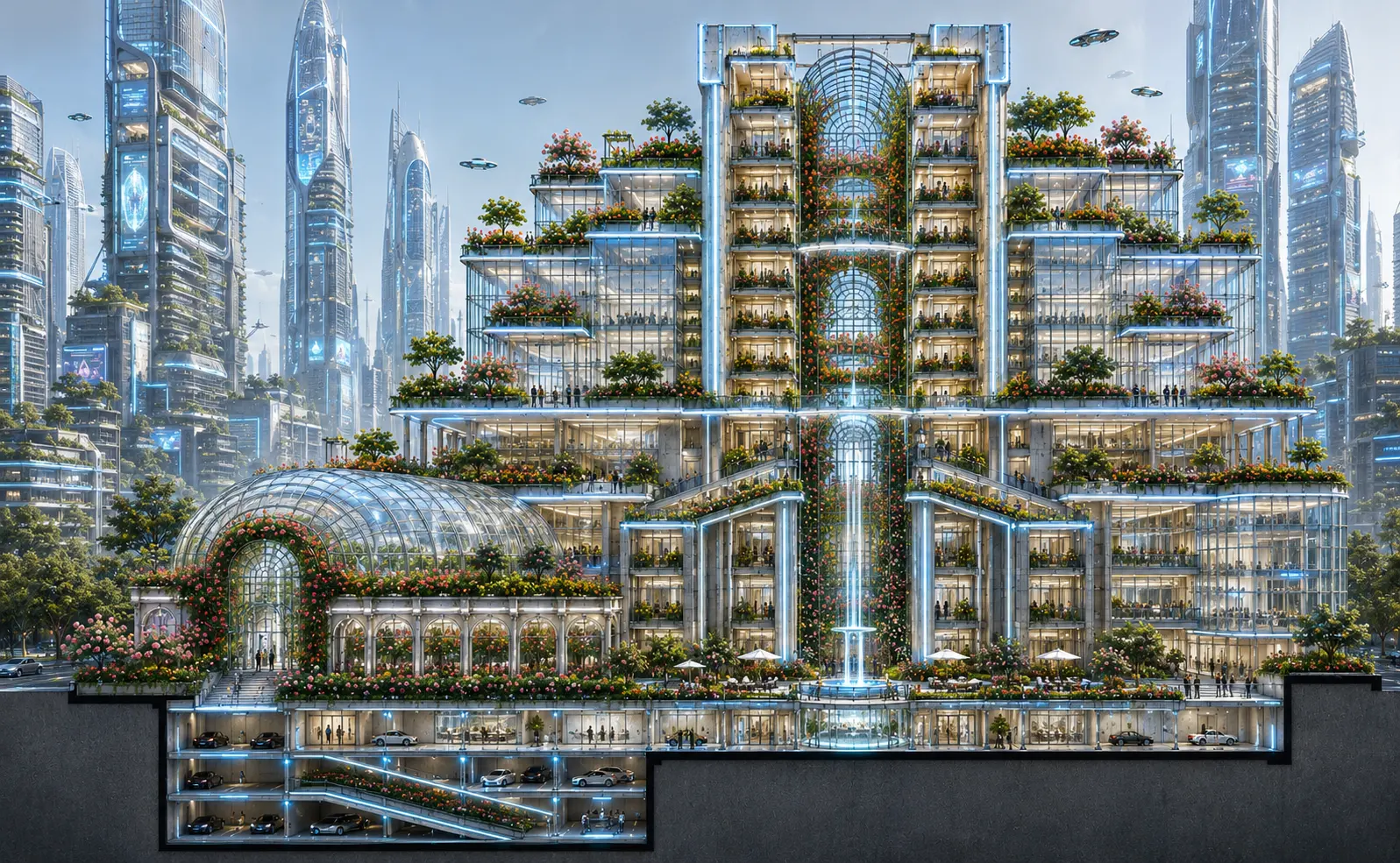
Photorealistic 3D CGI section render of a futuristic biophilic mixed-use building at night, set in a sci-fi city skyline. Glowing blue-white neon structural edges, glass conservatory with arched entrance at lower left, central internal waterfall in a tall atrium, rose and green gardens on every terrace, autonomous electric vehicles in underground parking and podium levels, drones flying overhead, holographic city towers in background, cinematic lighting, extreme detail, architectural cutaway section view.
Interior Environments & Net Zero Design
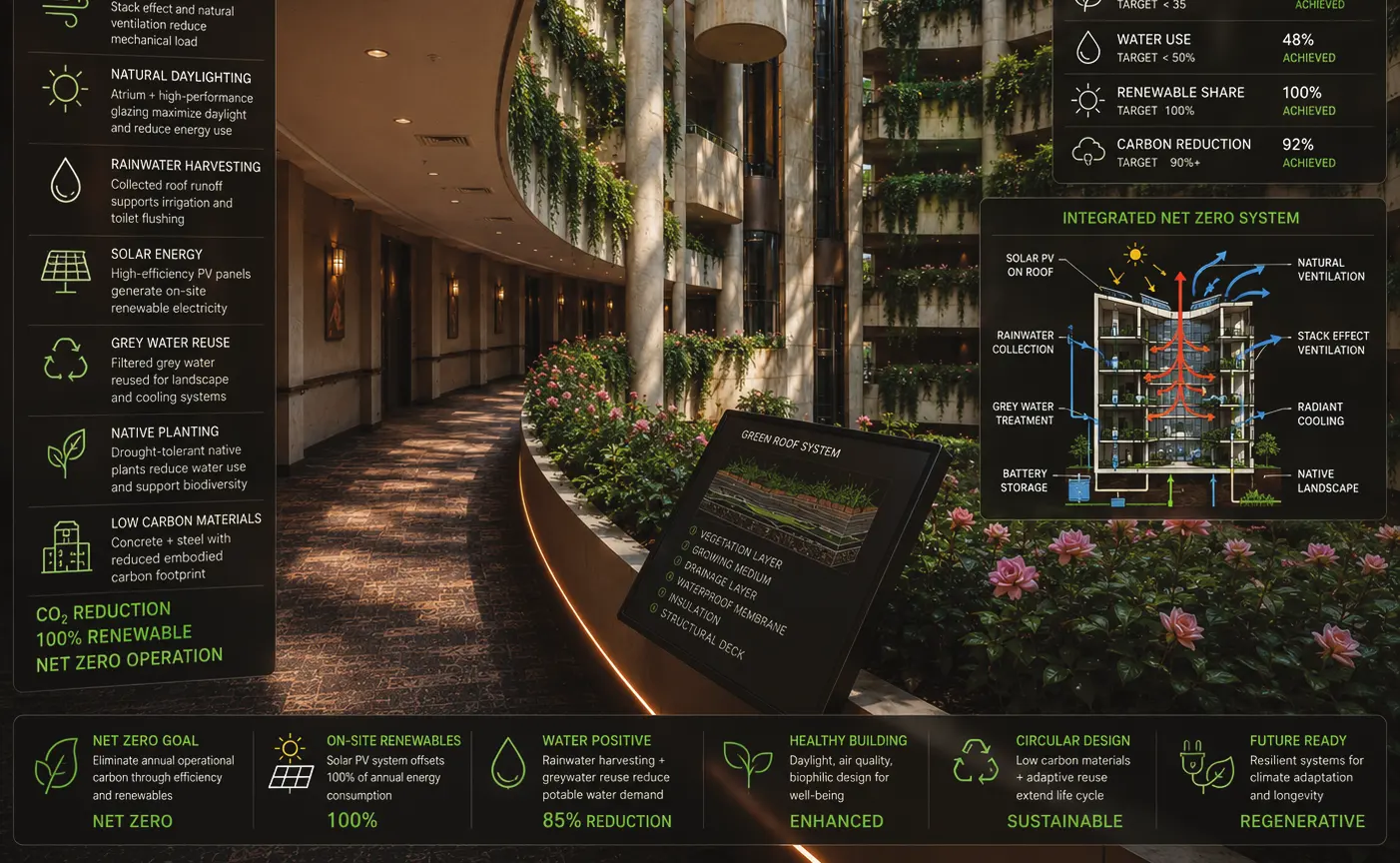
The Bonaventure’s interior atrium — a curved multi-storey corridor wrapping the central lift core — has always had the bones of something exceptional. This section pairs the existing condition with AI visualisations showing how that space could be transformed through biophilic design and Net Zero sustainability strategies.
28 kBtu/ft²/yr
Energy use intensity — target under 35, achieved.
100% renewable share
On-site solar PV covers the full demand — achieved.
92% carbon reduction
Against a 90%+ target — achieved.
85% water demand cut
Rainwater harvesting plus grey-water reuse.
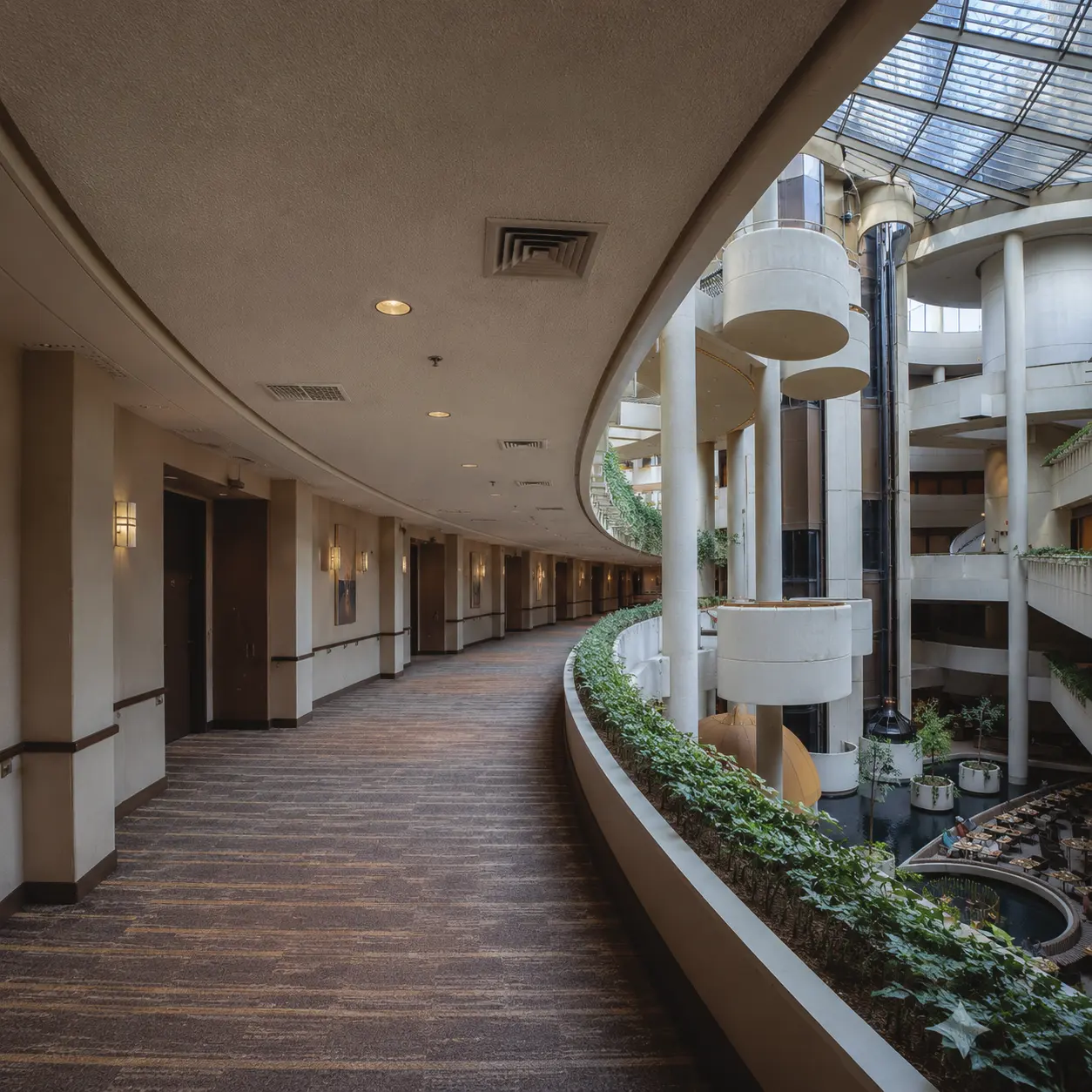
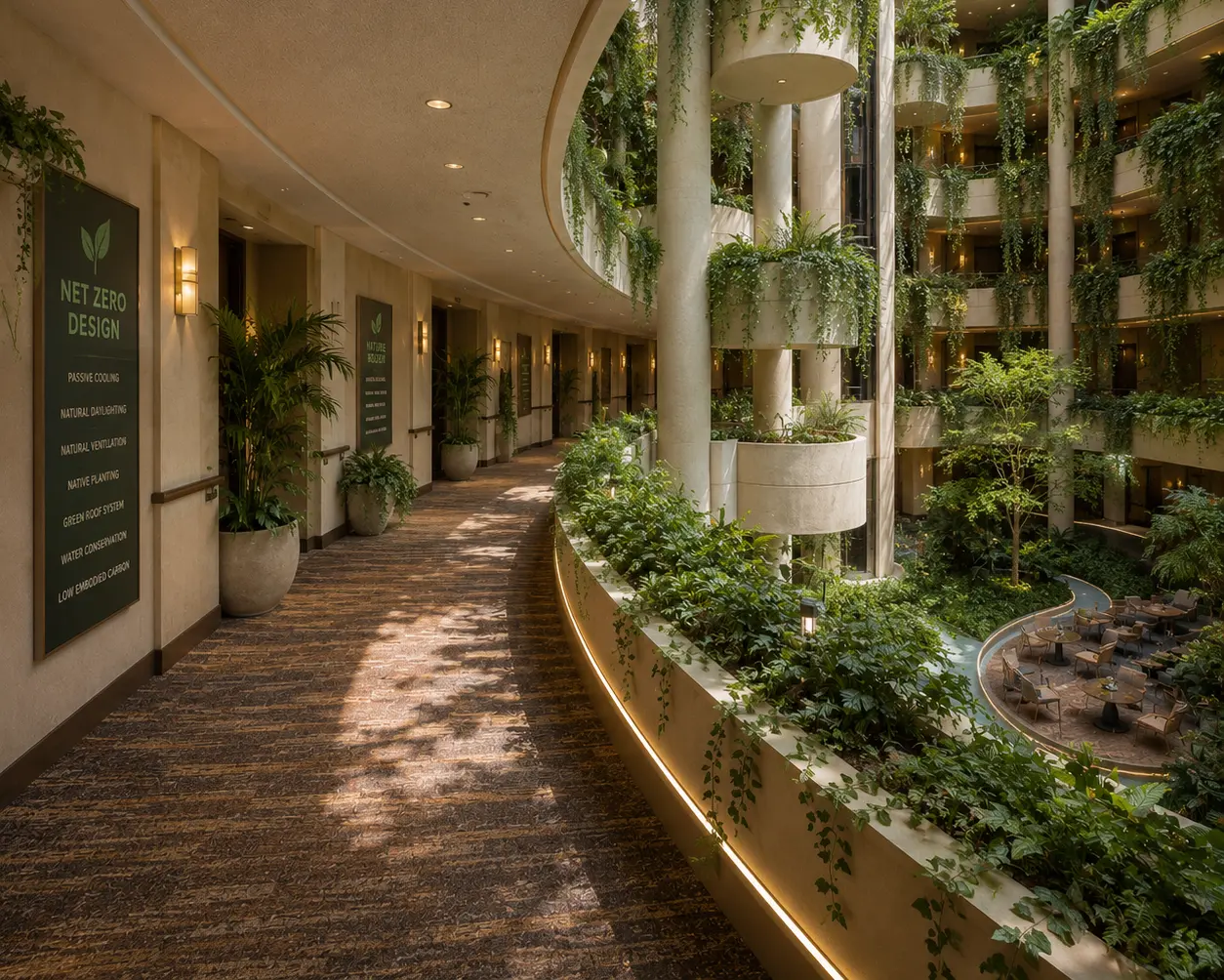
The same curved circular hotel atrium corridor transformed with lush cascading green walls on every balcony level, hanging vines and tropical plants, natural daylighting from above, warm ambient corridor lighting, Net Zero Design signage on left wall listing passive cooling, natural daylighting, native planting, green roof system, water conservation, low embodied carbon. Same architectural geometry as the input image, biophilic interior design, photorealistic.
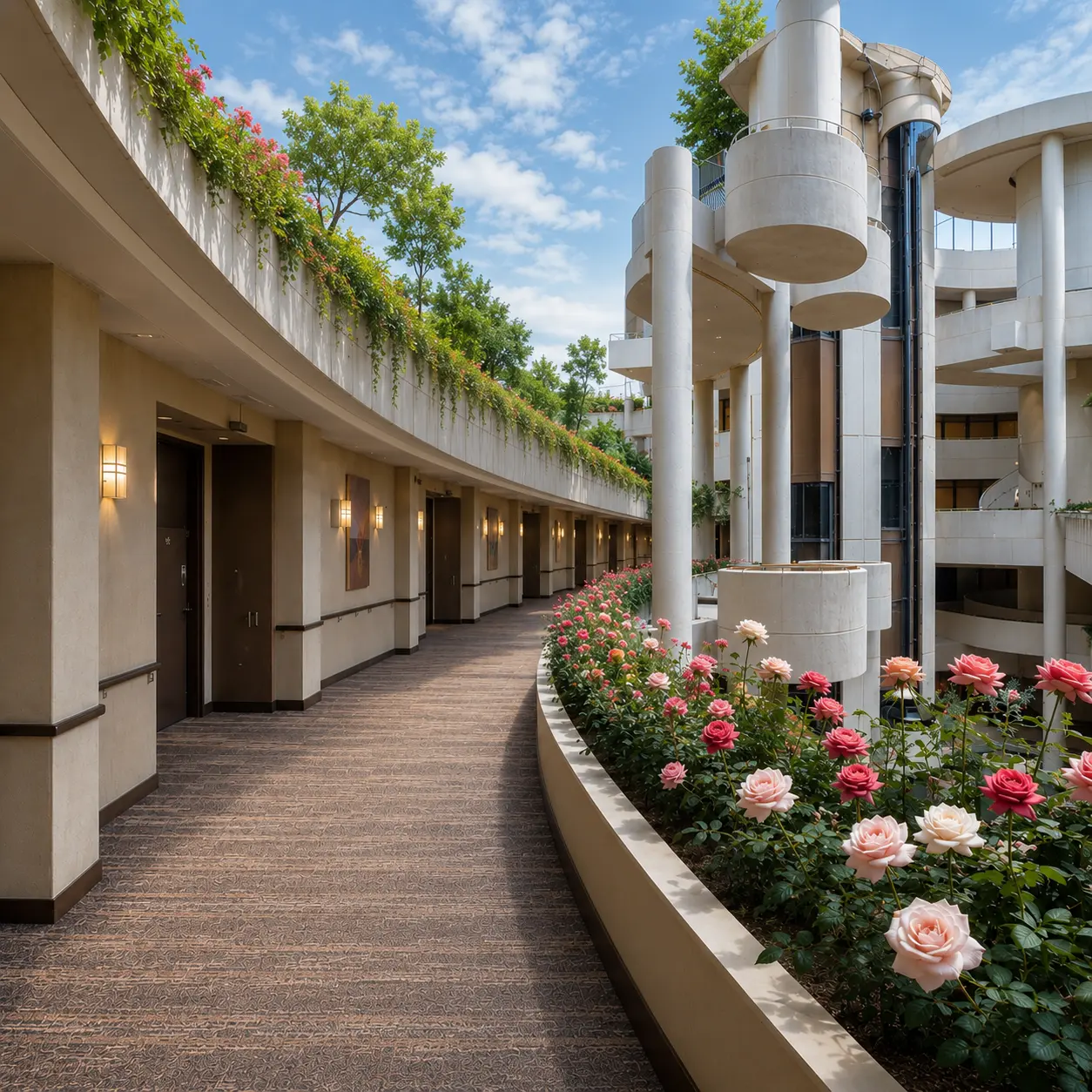
Working with image-to-image generation on an existing building — rather than starting from scratch — forced a more disciplined approach to prompting than I expected. The Westin Bonaventure’s geometry is unusual: five cylindrical towers, an internal atrium that curves around a central core, a podium that sits oddly between scales. Getting the AI to hold that geometry across iterations, rather than drift into generic “hotel lobby” territory, required a lot of specificity upfront.
The most effective technique across all three iteration sequences was anchoring each prompt to the architectural geometry first, then layering the atmosphere on top. Prompts that led with “cylindrical atrium corridor” or “stepped concrete podium” consistently produced more coherent outputs than prompts that led with mood — “lush biophilic interior” alone tended to generate beautiful images that had nothing to do with the Bonaventure. Once I found language that held the geometry, I could vary the rendering style — pencil, colour line, watercolour, CGI — without losing the building underneath.
For the section drawings, the image-to-image method worked surprisingly well because the pencil drawing already contained precise structural information. Each AI pass could read the massing and reinforce it, rather than having to invent it. The trickier iterations were the interior shots, where the AI kept trying to add elements that didn’t belong — overhead glass roofs, generic hotel furniture, decorative features that felt out of place. Removing unwanted additions required negative prompting (“no glass ceiling”, “no decorative columns”, “no chandeliers”) alongside the positive description.
The biggest lesson from this project was around iteration discipline. Early attempts tried to jump too far in a single prompt — asking for a watercolour atmospheric render while also holding the structural section. Slowing down, using each output as the literal input for the next pass, and keeping the prompt changes incremental produced far more coherent development. The CGI final iteration only worked as well as it did because it had three earlier passes to build from, rather than trying to leap directly from pencil to photorealistic render.
If I were to do this again, I’d spend more time in the prompt engineering of the base image — establishing clearer geometry, lighting conditions, and material language earlier — so that the later iterations had more to hold onto. The quality of each pass is only as good as the quality of what came before it.